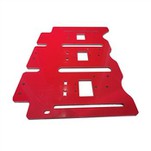
SMC (abbreviation for Sheet Molding Compound, i.e. sheet molding compound), carbon fiber SMC is a sheet formed by infiltrating chopped carbon fiber, matrix resin, additives and other materials according to a certain ratio, using professional molding processing equipment according to a certain process. shape molding compound.

Carbon fiber SMC molding refers to cutting carbon fiber SMC sheets according to product size, shape, thickness, weight and other requirements, and then stacking the cut materials into the heated metal mold cavity, pressing the preset Process molding conditions solidification molding process;
The SMC molding process has many advantages. For example, it is simple to operate, easy to automate, has a short production cycle, can form products with smooth surfaces and complex structures, can embed metal into molding, and has low waste. In addition, the carbon fiber SMC molding process can be used to obtain products. , its properties are also very good: excellent mechanical properties, thermal stability, chemical resistance, low heating shrinkage and low water absorption.
Carbon fiber SMC molding process

1) Material inspection The quality of carbon fiber SMC sheets has a great impact on the molding process and product quality. Therefore, before pressing, it is necessary to understand the quality of the material, such as resin type, fiber content, area density and unit weight, film peelability, and whether the material has expired, whether the fiber impregnation is good, whether there are impurities, whether the film covering is damaged, the material hardness and Quality uniformity, etc.
2 )Material cutting The material is thawed until there is no water mist on the surface of the PE bag and then cut. The shape and size of the sheet are determined according to the structural shape of the product, the feeding position, and the process. The size is usually 70%-100% of the projected area of the product surface. In order to prevent contamination from external impurities, the upper and lower films are removed before loading. At the same time, the working area is kept clean to avoid bringing in foreign matter.
3) Adjust press parameters ① Mainly includes "pressure", "temperature" and "molding time", which are determined based on product thickness, material requirements, mold conditions, etc. ② The mold must be installed horizontally and ensure that the installation position is in the center of the press table;
4) Clean mold ① The mold must be thoroughly cleaned first and the release agent must be applied. Before adding materials, the release agent must be wiped evenly with clean gauze to avoid affecting the appearance quality of the product. For new molds, oil must be removed before use. ②Clamp and heat the mold;
5) Check mold temperature ① Open the mold and use a contact thermometer to measure the temperature of the upper and lower molds in the cavity (note: measure several points at the front, back, left, center and right to ensure that the surface temperature of the mold reaches the pressing temperature required by the material. The core temperature is about 5 degrees lower than the mold cavity); ② If the temperature is not reached, close the mold and wait to continue heating; ③If the temperature reaches the upper and lower molds, spray release agent again.
6) Confirm the feeding amount and area ① Adding amount: The adding amount of each product can be calculated according to the following formula when pressing for the first time: Adding amount = product volume * density 1.5g/c㎡; ②Feeding area: The size of the feeding area directly affects the density of the product, the flow distance of the material and the surface quality of the product. It is related to the flow and solidification characteristics of SMC, product performance requirements, mold structure, etc. Generally, the feeding area is 70%-100%. If it is too small, the process will be too long, resulting in fiber orientation, reduced strength, increased waviness, and even failure to fill the mold cavity; ③Feeding position: The feeding position and method directly affect the appearance, strength and directionality of the product. Normally, the feeding position of the material should be in the middle of the mold cavity. For asymmetrical and complex products, the feeding position must ensure that the material flow reaches all ends of the mold molding cavity at the same time during molding.
7) High temperature and high pressure molding After the material block enters the mold cavity, the machine is started and the press moves down quickly. When the upper and lower molds are matched, the required molding pressure is slowly applied. After a period of heat preservation and pressure preservation, the molding of the product is completed. During the molding process, the molding process parameters should be reasonably set based on the material characteristics and press conditions. ①Molding temperature: The molding temperature depends on the curing system of the resin paste, the thickness of the product, the production efficiency and the complexity of the product structure. The molding temperature must ensure that the curing system is initiated, the cross-linking reaction proceeds smoothly, and complete curing is achieved. The molding temperature of carbon fiber SMC is generally between 130-140℃. Generally speaking, the molding temperature selected for thicker products should be lower than that of thin-walled products. This can prevent excessive heat accumulation inside thick products due to excessive temperature. As the molding temperature increases, the corresponding curing time can be shortened; conversely, when the molding temperature decreases, the corresponding curing time needs to be extended. The molding temperature should be chosen as a trade-off between maximum curing speed and optimal molding conditions.
②Molding pressure SMC molding pressure varies with the product structure, shape, size and SMC thickening degree. Products with simple shapes require less pressure, while products with complex shapes require greater pressure. The higher the thickening degree of SMC, the greater the molding pressure required. Products with high requirements on appearance performance and smoothness require higher molding pressure during molding. In short, many factors should be considered when determining the molding pressure. Generally speaking, the carbon fiber SMC molding pressure is between 10-25Mpa ③Molding time: The curing time of carbon fiber SMC at the molding temperature (also called the holding time) is related to its properties, curing system, molding temperature, product thickness and color and other factors. Carbon fiber SMC molding time is usually between 10-15 minutes. Since SMC is a rapid curing system, rapid closing of the press is very important. If the press closes too slowly after adding materials, pre-cured patches will easily appear on the surface of the product, or material shortages or oversize may occur. While achieving fast closing, the mold closing speed should be carefully adjusted at the end of the press stroke. When the mold is a certain distance from closing, the mold closing speed should be slowed down to facilitate exhaust.
8) Demolding and appearance inspection ①Slowly open the upper mold. After it rises to 10mm, confirm whether the product is jammed. After confirming that the product remains in the lower mold, move the upper mold to the upper limit position. Open the top mold mechanism and slowly lift it up to take out the product; ② Check the appearance of the product to see if there is any missing material, dirt, pores, dry yarn, etc. If the product does not require painting, repair the overflowing burrs to complete product production;