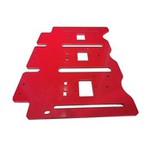
The differences in core parameters between PFCP201 (phenolic laminated cardboard) and GPO3 (unsaturated resin laminated sheet) are concentrated in four dimensions: substrate composition, heat resistance, electrical stability, and water absorption. The specific comparison of core parameters and key differences are as follows:
1, Comparison Table of Core Parameters
Parameter category comparison item
PFCP201 GPO3
Basic properties: The substrate consists of cellulose fiber paper, phenolic resin, alkali free glass fiber felt, and unsaturated polyester paste
Density (g/cm ³) 1.30~1.45 1.90~2.05
Temperature index (℃) 120 155
Mechanical properties: Vertical layer bending strength (MPa) ≥ 135 ≥ 180
Compressive strength (MPa) ≥ 3000 (vertical layer direction) ≥ 300 (vertical layer direction)
Impact strength (KJ/m ²) - ≥ 60
Electrical performance: Arc resistance (sec) - ≥ 180
Tracking resistance index (V) - ≥ 600
Volume resistivity (Ω. m) - ≥ 1.0 × 10 ¹⁰
Parallel layer breakdown voltage (KV/25mm) - ≥ 80
Physical properties: High water absorption rate (1mm thickness ≤ 450mg), extremely low (≤ 0.5%)
Flame retardant rating - UL 94 V-0 grade
2, Summary of Key Differences
1. Substrate and basic performance: PFCP201 uses paper as the substrate, with lower density and better cost; GPO3 is based on glass fiber, with higher density and more stable structure, suitable for high demand scenarios.
2. Heat resistance and environmental adaptability: The heat resistance level of GPO3 (155 ℃) is much higher than that of PFCP201 (120 ℃), and it can work stably in the range of -273 ℃ to 155 ℃, with stronger resistance to thermal shock; PFCP201 is only suitable for medium to low temperature environments.
3. Electrical stability: The arc resistance, electrical trace resistance, and volume resistivity of GPO3 are significantly better than PFCP201, and the electrical performance degradation is minimal in high humidity environments; PFCP201 has weak electrical performance under normal humidity and low insulation resistance after immersion in water.
4. Water absorption and durability: GPO3 has an extremely low water absorption rate (≤ 0.5%) and strong moisture and corrosion resistance; PFCP201 has high water absorption (up to 450mg in 1mm thickness), and long-term humid environments can easily affect its performance, making it more suitable for dry or oil immersed scenarios.
5. Mechanical strength emphasis: PFCP201 has extremely high vertical layer compression strength (≥ 3000MPa) and outstanding compressive strength; GPO3 has better bending strength and impact strength, and stronger resistance to fracture and impact.