


Our factory covers an area of 10,000 square meters,owing 12 advanced hydraulic press and max press is 3000 tons.We also have CNC machine and surface grinding machine for sheet machining compenent part production.We have a variety of molding process means, such as molding, pultrusion, injection molding, blister, hand-made glass fiber reinforced products.We are glad to accept customer's product design and customer's requirements and will choose the most appropriate production solutions,striving to provide customers with a full range of systematic services.
Why Choose Us
Our Product
Our main products are SMC Fiberglass Insulation Sheet,GPO-3(UP GM203)Glass mat Insulation Sheet,and various SMC molded products, such as SMC medical enclosure/Shell,SMC Automobile exterior parts and other products.Our annual supply of composite material is over 3000tons.
Production Equipment
We have automatic sheet moulding compound batching equipment.12 advanced hydraulic press and max press is 3000 tons.6 CNC machines and 2 surface grinding machine.
Production Market
Our GPO-3 UPGM203 and SMC Insulation sheet,machining compenent parts and FRP pultruded profile,moulded product exported U.S market,Europe market such as Germany,Italy,Spain,France,Czech,Asian market of Malaysia,Vietnam,India and middle east market.
Our Service
We have benn always adhering to the business philophy of "customer-oriented, quality-assured, continuous improvement" and provides high quality environmental protection and high performance insulation materials for our customers.

GPO-3 is a fibreglass laminate with excellent thermal, mechanical, and electrical qualities for applications up to 155°C. It is made of polyester resin reinforced with fibreglass mat foundation.

UTR GPO-3 Electrical Grade Fiberglass Unsaturation Resin Sheet
UTR sheet,als known as GPO-3 sheet,UPGM203 sheet, is a thermoset unsaturation polyester polymer with fiberglass mat reinforcement.

Thickness 30mm GPO-3 Molded Red Insulation Sheet
Unsaturated Polyester Glass Mat is known by the initials UPGM203. Since 2002, we have focused on producing UPGM203 sheet (also known as GPO-3 sheet). We are a reputable firm that combines the production of UPGM203 sheet with Glass Mat prepreg.

Electrical Grade GPO-3 Sheet For Arc Isolators
GP0-3 board is made of alkali free glass fiber felt sheet immersed with unsaturated polyester resin add additive by hot press to form into hard sheet insulation. GPO-3 is a glass reinforced thermoset polyester sheet material.

Unsaturation Resin Fiberglass Electrical Insulating Board
SMC Insulation Board is a multivalent electrical insulating rigid sheet made of fiberglass impregnated with high-grade polyester resin and various additives and pressed at high temperatures.

GPO-1 GPO-2 GPO-3 Fibreglass Laminate Sheet
GPO-1 GPO-2 GPO-3 are created from a mixture of randomly arranged glass fibers that have been saturated with polyester resin and added to the right fillers.

SMC Polyester Fiberglass Sheet Flat Board
SMC Insulating Sheet is produced using a high temperature, high pressure moulding technique to inject chopped fibreglass strands with unsaturated polyester resin. It is a superb FRP insulator of a certain sort.

Unsaturation Resin Fiberglass Sheet
Fiberglass Sheet is a multivalent electrical insulating rigid sheet made of fiberglass impregnated with high-grade polyester resin and various additives and pressed at high temperatures.

180℃ High-Temperature Resistant SMC Insulation Sheet
High-temperature resistant SMC insulation sheet, also known as sheet molding compound insulation sheet, is widely used in a variety of industries due to its excellent heat resistance, fire resistance, and insulation properties.
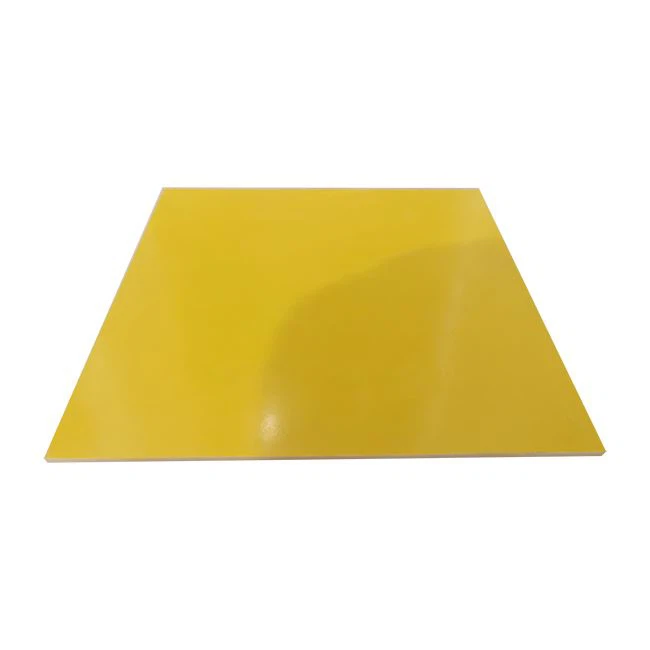
SMC Yellow Insulation Sheet is a multivalent electrical insulating rigid sheet made of glass fiber impregnated with high-grade polyester resin and various additives and pressed at high temperatures. SMC uses long glass fibers, GPO-3 uses glass fiber mats, and BMC uses chopped glass fibers. SMC Insulating Sheet is produced using a high temperature, high pressure moulding technique to inject chopped fibreglass strands with unsaturated polyester resin. It is a superb FRP insulator of a certain sort. There are numerous colours available for the SMC Insulating Sheet. Therefore, our products have good electrical properties, mechanical properties, arc resistance, and other properties.
Advantages of SMC Yellow Insulation Sheet
Mechanical properties
SMC insulating plates will be affected by various external forces during use. For example, the insulating plates used in high-voltage large-capacity generators must be able to withstand high mechanical stress caused by high-speed rotation, starting and stopping, and sudden short circuits. Therefore, higher machinery is required. Performance, including tensile strength and elongation at break.
Thermal stability
Thermal stability is a very important indicator of SMC insulation board. It is a major factor in the aging of low voltage insulation and determines its service life. Under normal operating conditions, the electric field strength has only a slight influence on the insulation aging process. Insulating board used in a relatively high temperature environment for a long time will become brittle due to thermal aging and gradually lose its mechanical and electrical properties.
Electrical performance
Insulating plates are widely used in electrical equipment, so they need to meet certain electrical properties. The electrical performance of an insulating board refers to its conductance, dielectric loss and breakdown characteristics under the action of an electric field.
How Do You Choose SMC Yellow Insulation Sheet
Environments
Insulation sheet are essential for reducing heat loss or gain in various environments, such as buildings, pipes, tanks, or vehicles. However, not all insulation sheet are suitable for every situation. You need to consider factors such as thermal conductivity, density, thickness, cost, durability, fire resistance, and environmental impact when choosing the best insulation material for your project.
Thermal conductivity
Thermal conductivity is a measure of how easily heat can flow through a material. It depends on the material's structure, composition, temperature, and moisture content. The lower the thermal conductivity, the better the insulation performance. You can find the thermal conductivity values of common insulation sheet in tables or charts online or in reference books. You can also use formulas or software tools to calculate the thermal resistance or R-value of an insulation layer, which is the ratio of its thickness to its thermal conductivity. The higher the R-value, the more effective the insulation.
Density and thickness
Density and thickness are related to the mass and volume of an insulation material. They affect its thermal capacity, which is the amount of heat that can be stored or released by a material. Generally, higher density and thickness mean higher thermal capacity, which can help reduce temperature fluctuations and improve comfort and energy efficiency. However, they also mean higher weight and cost, which can limit the design and installation options.
Cost and durability
Cost and durability are important factors to consider when choosing an insulation material. Cost includes not only the initial purchase price, but also the installation, maintenance, and replacement costs. Durability refers to how well an insulation material can withstand physical, chemical, and biological damage over time. You want to choose an insulation material that has a low life cycle cost and a long service life. You also need to consider the availability and accessibility of the insulation material in your location and market.
Fire resistance
Fire resistance is the ability of an insulation material to resist ignition, combustion, and spread of fire. It depends on the material's flammability, combustibility, and fire rating. Flammability is the ease of ignition of a material. Combustibility is the amount of heat and smoke produced by a burning material. Fire rating is the classification of a material based on its performance in standard fire tests. You need to choose an insulation material that meets the fire safety requirements and regulations of your project. You also need to consider the potential fire hazards and risks of your environment.
Environmental impact
Environmental impact is the effect of an insulation material on the natural environment and human health. It includes factors such as embodied energy, greenhouse gas emissions, resource depletion, waste generation, toxicity, and recyclability. Embodied energy is the amount of energy consumed during the production, transportation, and disposal of a material. Greenhouse gas emissions are the gases that contribute to global warming and climate change. Resource depletion is the reduction of natural resources due to extraction and consumption. Waste generation is the amount of solid or liquid waste produced by a material. Toxicity is the degree of harm caused by a material to living organisms. Recyclability is the ability of a material to be reused or recovered. You need to choose an insulation material that has a low environmental impact and a high sustainability.
Different SMC Yellow Insulation Sheet Insulation Compounds


Loose-Fill and Blown-In Insulation
Vermiculite, or asbestos, manufacturers also made loose-fill and blown-in insulation with other materials. Sometimes it contains cellulose, fiberglass, and mineral wool.
Blanket – Batt, and Roll
As the name implies, this type of insulation looks like a spongy, pink, or yellow blanket when found in the attic or wall spaces. Usually, batt and roll insulation encompasses fiberglass, mineral wool, plastic, and natural fibers.
Concrete Block/Forms
Insulation that encompasses concrete can work for two kinds of concrete structures, blocks, and forms. Molded expanded polystyrene (MEPs) foam insulation reinforces concrete blocks. These are recently completed, as well as existing cement infrastructures. Expanded and extruded polystyrene (EPS, XPS) and cementitious spray insulation foams protect concrete forms, or unfinished walls, foundation, and new construction.
Foam Board/Rigid Foam
Made of polystyrene, polyisocyanurate, and polyurethane, this type of insulation compound is thick and can reinforce unfinished walls, floors, ceilings, and unvented low-sloped roofs.
Spray/Cementitious Foam
As the name implies, cementitious means the foam is cement-based and comes in spray-on form. Good for enclosed walls, new wall cavities, and unfinished attic floors and walls.
Phenolic Foam
Also, a spray-on foam, phenolic compounds are more rigid and use air as the foaming agent. Phenolic foam shrinks approximately 2% once dried, which makes this material less desired by insulators. It also contains parts of cement, polyisocyanurate, polyurethane materials.
Structural Panels
Rigid panels used for insulation that have internal core reinforcement of liquid, foam insulation, or straw compounds. This type works with unfinished walls, ceilings, and floors, roofing, or new builds.
Reflective
Made with paper and plastic fibers like foil-faced kraft paper, plastic film, polyethylene bubbles, or cardboard.
How To Judge Whether The Smc Yellow Insulation Sheet Is Good
To correctly judge whether the SMC insulation board is of good quality, then we need its material to start, and the method of inspecting the material is to analyze and inspect these materials, and then under the premise of ensuring its performance, it can still meet The basic inspection principle, and its insulation is one of the very important factors. Whether the quality of the product is good or not is the prerequisite that affects the normal work. Then we will briefly understand how to judge.
It should have strong combustion resistance.
When the insulating material is in contact with the flame, it has a stronger ability to resist burning or stop burning when leaving the flame, because the higher the burning resistance, the better the safety.
A good SMC insulation board should have high insulation resistance and resistivity.
Resistance is the reciprocal of conductance, and resistivity is the resistance per unit volume. The less conductive the material, the greater its resistance, and the two are in a reciprocal relationship. For insulating materials, it is always desirable to have the highest resistivity as possible.
It should have good tensile strength.
In the tensile test, the specimen is subjected to a relatively large tensile stress, and this is a very representative test for the mechanical properties of insulating materials.
Under the specified test conditions, the ability of the SMC insulation board to withstand the arc action along its surface. During the test, use AC high voltage and small current to determine the arc resistance of the insulating material by the time required for the formation of a conductive layer on the surface of the insulating material by the arc generated by the high voltage between the two electrodes. The greater the time value, the arc resistance The better.
It is a roll-shaped insulating material made of alkali-free glass fiber cloth used for electricians as a reinforcing material, bonded with high-temperature silicone resin, and processed by high-temperature baking, drying, and pressing. The finished paper roll is dry, non-adhesive, and has good flexibility and flexibility. Compared with soft boards, it has stronger tensile strength. Compared with tape-type insulating materials, its thickness is increased, and the single layer is resistant to voltage breakdown. More capable. With superior electrical insulation performance and high temperature resistance, it is especially suitable for high temperature insulation of various industrial electric furnaces, power frequency furnaces, refining furnaces, intermediate frequency furnaces, calcium carbide furnaces, submerged arc furnaces, ferroalloys, electric arc furnaces, etc. in the steel, metallurgical and other industries.
SMC yellow insulation sheet has high mechanical strength, flame retardant, leakage resistance is second only to UPM203; Arc resistance, dielectric strength and high voltage resistance; Low water absorption, size stability, small warpage and other characteristics. SMC insulation board products are mainly used in high, medium and low voltage switchgear insulation partition. SMC composite material performance, unique solution to wood, steel, plastic meter box easy to aging, easy to corrode, poor insulation, cold resistance, poor, the shortcomings of poor flame retardancy, short service life, excellent properties of glass fiber reinforced plastic meter box, has absolute seal waterproof performance, corrosion performance, preventing electricity-stolen performance, no need to ground wire, appearance beautiful, have a lock on security protection and sealing, long service life.
Insulation materials are commonly used products by electricians. There are many types of insulating materials, such as electrical insulating paint, Insulation sheets,electrical composite insulating paper, insulating board, insulating film (polyester film/polyimide film, etc.).
The function of insulating materials is to isolate live parts of different potentials in electrical equipment. The insulating material has high insulation resistance and compressive strength, and can avoid accidents such as leakage and breakdown. Secondly, the heat resistance should be good, to avoid long-term overheating and aging and deterioration; in addition, it should also have the characteristics of good thermal conductivity, moisture resistance and lightning protection, high mechanical strength and convenient processing.
Classification of heat-resistant grades of insulating materials:
- According to the degree of heat resistance, the insulating materials are divided into 7 grades: Y, A, E, B, F, H, C, etc.:
- Y-class insulation temperature resistance 90 ℃ A-class insulation temperature 105 ℃
- Class E insulation temperature resistance 120°C Class B insulation temperature resistance 130°C
- Class F insulation temperature resistance 155℃ H class insulation temperature resistance 180℃
- Class C insulation temperature resistance above 200 ℃.
In order to ensure better quality of insulation board, insulation board manufacturers need to dehumidify its raw materials.
There are two kinds of drying equipment for insulation board raw materials, namely hot air dryer and dehumidification dryer. The principle of the hot air dryer is to use hot air to blow away the moisture in the raw materials of the insulating board. The temperature range is 80-100℃, and the drying time is mostly 40-60min.
The principle of the dehumidifying dryer is to replace the moisture in the hot air with molecular sieves, and then use the drying air to blow away the moisture in the raw materials of the SMC insulation board. Using this method, the moisture in the raw materials can be reduced to less than 0.1%, and the drying temperature is generally At 80-100℃, the drying time is generally 2-3h, and a dryer with stable performance can reduce the dew point of the drying air to below -30°C; if the moisture content in the raw material is greater than 0.08%, a hot air dryer needs to be used for pre-drying.
What Factors Affect The Electrical Strength Of SMC Yellow Insulation Sheet
Sample thickness
When the insulating material is very thin, the breakdown voltage is proportional to the thickness, that is, the electrical strength is independent of the thickness. When the thickness of the insulating material increases, it will be difficult to dissipate heat, and factors such as impurities and bubbles will reduce the electrical strength.
Temperature
Above room temperature, the electrical strength decreases as the temperature rises.
Humidity
Water enters the insulating material. The electrical strength decreases.
Voltage action time
For most organic insulating materials, the electrical strength decreases as the voltage action time increases. During the test, the faster the voltage increase speed, the higher the electrical strength. The longer the voltage action time of step-by-step or slow voltage increase, the better it can reflect the thermal effect and the existence of defects such as air gaps inside the material. Therefore, the general test method stipulates that the impact voltage increase method should not be adopted, but the continuous voltage increase or step-by-step voltage increase method should be adopted.
Mechanical stress or mechanical damage
The electrical strength of the insulating material will be reduced after being subjected to mechanical stress or mechanical damage. The processing of laminated product samples should try to avoid strong damage, and milling should be used instead of cutting, and the processing feed should be controlled to be small.
Sample
The sample cannot be contaminated, and the thin insulating board sample cannot have wrinkles. The breakdown voltage will be reduced.
Water or carbon in the transformer oil
If the sample is to be tested for breakdown in transformer oil, the transformer oil should meet the standard requirements. Over time, the transformer oil absorbs moisture and has residual carbon from multiple breakdowns, which will reduce the breakdown voltage of the sample. The transformer oil should be treated or replaced in a timely manner.
FAQ
Q: What is the difference between prepreg and SMC?
Q: What is SMC FRP?
Q: What is the difference between SMC and DMC insulators?
Q: What is the thermal conductivity of SMC?
Q: What is SMC material used in insulation?
Q: What are the raw materials of SMC?
Q: What is SMC insulator?
Q: What is SMC synthetic?
Q: How to calculate thermal conductivity of insulation?
An example: 10 cm of insulating material with a ƛ of 0.05 W/mK results in a R-value of 2 m2K/W. The better the insulating material (lower ƛ), the thinner the layer insulation needs to be to achieve the same result in terms of thermal insulation.
Q: What is the principle of SMC?
Hot Tags: smc yellow insulation sheet, China, manufacturers, cheap, quotation, free sample, 4x8 inch laminate sheet, telecommunication insulation sheet, heat insulation solution, cellulose insulating product, cellulose insulating solution, uv resistant insulation sheet


