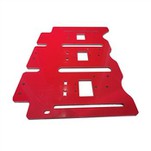
In 2025, the epoxy board market is expected to remain stable and rise, with a global scale of approximately 12.5-13 billion US dollars, representing a year-on-year increase of 5.5% -6.5%; China's GDP is about 11-12 billion yuan, with a growth rate of 8% -9%, higher than the global average. New energy, electronic information, and power equipment are the core engines.
1, Scale and growth rate
-Global: Approximately 11.8 billion US dollars in 2024, with an increase of 5.5% -6.5% in 2025; The CAGR from 2025 to 2030 is approximately 6.0% -6.8%.
-China: By 2025, the scale will reach 11-12 billion yuan, with a growth rate of 8% -9%, accounting for over 40% of the global market share; The demand for epoxy glass cloth board is about 60 million square meters, and the demand for copper-clad epoxy laminated board is about 1.1 million tons.
-Drivers: Electronic information, new energy, upgrading of power equipment, acceleration of 5G and data center construction.
2, Core driving factors
1. Electronic information: The demand for high-performance epoxy boards (high-frequency, high heat resistance, low dielectric loss) driven by 5G base stations, servers, and new energy vehicle electronic control has increased to 42% in 5G base station applications.
2. New energy: The demand for insulation/structural components in wind turbine blades, photovoltaic inverters, and energy storage equipment has increased significantly, and the demand for extruded epoxy boards in the wind power sector will exceed 80000 tons by 2025.
3. Power equipment: Medium and low voltage switchgear and transformers have been updated, and the demand for epoxy boards as insulation partitions/busbar clamps has steadily increased.
4. Policies and standards: Upgrading environmental and safety standards, accelerating the replacement of traditional materials with halogen-free, low VOC, UL94 V-0 epoxy boards.
3, Competitive landscape
-International: Rogers, Panasonic, R ö chling and other technology and brand leaders monopolize high-end markets such as high-frequency and high-speed, automotive grade, etc., with a premium of 15% -20%.
-Domestic: Local enterprises have an advantage in cost and delivery, with an increase in their share of the mid to low end market; Head (Shengyi, Ultrasound, South Asia) is accelerating integration, increasing concentration, and small and medium-sized enterprises rely on customization to maintain a premium of * * 6% -8% * *.
-Trend: High end high-performance, mid-range scale cost reduction, low-end environmental protection transformation.
4, Challenges and Risks
-Cost pressure: Fluctuations in prices of epoxy resin and fiberglass compress profits; Large scale enterprises reduce costs through upstream integration (resin self supply rate of over 80%).
-Technical barriers: High frequency and high-speed, high heat resistance (200 ℃+), low dielectric loss (Dk<3.8) and other high-end product research and development investments are large, and there is still a gap for domestic enterprises.
-Alternative threats: PI, PPO, SMC/BMC, etc. divert demand in some scenarios, forcing epoxy board performance upgrades.
-Homogenized competition: overcapacity in the mid to low end, price wars leading to a decline in gross profit to 10% -15%; The gross profit margin of high-end products can reach 20% -25%.
5, Regions and Applications
-Asia Pacific: China, India, and Southeast Asia account for approximately 45% of demand, with the fastest growth rates; China is the world's largest producer and consumer country.
-North America: Driven by data centers and new energy vehicles, with a share of approximately 22%.
-Europe: Green energy transition, driven by offshore wind power to meet special operating conditions, with a growth rate of approximately 7.5%.
-Applications: Copper clad laminates (accounting for over 40%), insulation structural components, wind turbine blades, aerospace structural components, and rail transit insulation components.
6, Price and Profit
-Price: Stable and rising in 2025, with a price range of 100-150 yuan/square meter for general use and 300-800 yuan/square meter for high-end customization (high-frequency/high heat resistance).
-Profit: Large scale enterprises have a gross profit margin of 17% -20%, while small and medium-sized enterprises have a gross profit margin of 10% -15%; High end products can achieve a gross profit margin of 20% -25% due to technological barriers.
7, Summary and Prospect
Strong growth certainty in 2025, with China as the core engine; Enterprises need to focus on the high prosperity track of new energy and electronic information, improve product performance and customization capabilities, and hedge costs and competitive pressures.