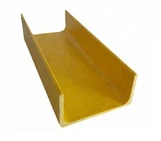
Hey there! As a supplier of FRP Angle Profile, I often get asked, "What is the standard size of FRP Angle Profile?" Well, let me break it down for you.
First off, FRP, which stands for Fiber - Reinforced Plastic, is a super useful material. It's strong, lightweight, and resistant to corrosion, making FRP Angle Profile a top - choice for a bunch of applications, from construction to industrial setups.
Now, when it comes to the standard sizes, there isn't one - size - fits - all. The most common sizes for FRP Angle Profile are determined by the leg length and the thickness of the material.
Common Leg Lengths
In the market, leg lengths can vary quite a bit. You'll often find leg lengths ranging from 25mm to 200mm. For small - scale projects or in situations where space is limited, a 25mm to 50mm leg length might do the trick. For instance, if you're building a small shelving unit or a DIY project at home, the shorter leg lengths can offer the necessary support without taking up too much space.
On the other hand, for larger industrial structures or heavy - duty construction work, leg lengths of 100mm to 200mm are more commonly used. These longer leg lengths provide greater stability and can handle higher loads. Let's say you're constructing an industrial platform. A FRP Angle Profile with a 150mm leg length would be much better at supporting the weight compared to a 50mm one.
Thickness Variations
The thickness of the FRP Angle Profile also plays a crucial role. Thicknesses usually range from 2mm to 12mm. Thinner profiles, around 2mm to 5mm, are great for non - load - bearing applications. For example, in decorative work or as a finishing touch, these thinner profiles can be used. If you want to add a sleek edge to a wooden structure, a 3mm thick FRP Angle Profile can be a perfect fit.
But when you're dealing with high - stress situations or heavy loads, thicker profiles are essential. A profile with a thickness of 8mm to 12mm can withstand a lot more pressure. In outdoor construction where the structure has to bear the weight of people, equipment, and withstand environmental factors, such thicker profiles are a must - have.
Custom Sizes
However, it's important to note that just because there are common sizes doesn't mean we're restricted to them. As a supplier, I know that every project is different, and sometimes, the standard sizes won't cut it. That's where custom sizes come in. If your project requires a very specific leg length or thickness, don't worry! We can manufacture FRP Angle Profiles according to your exact specifications. Whether you need a very short leg with a thick profile or a long, thin one, we've got you covered.
Applications and Size Consideration
Let's talk about some applications and how size selection matters.
Construction
In construction, the size of the FRP Angle Profile can significantly impact the overall strength and durability of the structure. For building facades, you might use a medium - sized profile with a leg length of around 50mm - 75mm and a thickness of 4mm - 6mm. This can provide enough support while also allowing for a clean and aesthetic look.


When it comes to constructing staircases or walkways, you'll want a more robust profile. A leg length of 100mm - 150mm and a thickness of 8mm - 10mm are typically recommended. This ensures the safety and longevity of these high - traffic areas.
Industrial Settings
In industrial environments, where there are heavy machinery and equipment, larger and thicker FRP Angle Profiles are often required. For machinery enclosures, a leg length of 150mm - 200mm and a thickness of 10mm - 12mm can be used to provide a sturdy and reliable frame.
If you're interested in other related products, I'd like to tell you about SMC Molding Press Enclosure and SMC Cable Tray. These are great options for industrial applications and can complement the use of FRP Angle Profiles in many projects. They offer similar benefits such as durability and corrosion resistance.
As an FRP Angle Profile supplier, I always strive to offer the best quality products. Our manufacturing process ensures that each profile meets high - quality standards, regardless of its size. We use advanced technology and high - grade materials to make sure that the profiles are not only strong but also have a long service life.
Quality Assurance
When you're looking for FRP Angle Profiles, quality is key. You don't want to end up with a product that breaks easily or doesn't perform as expected. That's why our products go through a series of quality checks. We test for strength, corrosion resistance, and dimensional accuracy. Only after the profiles pass these strict tests do they leave our factory and make their way to your project.
Choosing the Right Supplier
Now, finding a reliable supplier is just as important as choosing the right size. When you're sourcing FRP Angle Profiles, look for a supplier who can offer a wide range of sizes, both standard and custom. You also want a supplier who has a good reputation for quality and customer service.
At our company, we're committed to making sure our customers are satisfied. We offer expert advice on size selection based on your project requirements. Whether you're a small - scale DIY enthusiast or a large construction company, we're here to help you find the perfect FRP Angle Profile.
So, if you're in the market for FRP Angle Profiles, don't hesitate to reach out. We can discuss your project in detail and figure out the best size and type of profile for you. Whether it's a standard size or a custom order, we've got the expertise and resources to meet your needs. Contact us today to start the procurement process and let's make your project a success!
References
- Industry standards for FRP products
- Practical applications of FRP Angle Profiles in construction and industry