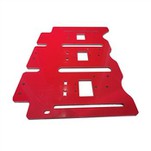
The combination of unsaturated resin and carbon fiber makes SMC components with excellent comprehensive properties, including high mechanical strength, low density, low emissions, and online coating, while maintaining the unique design flexibility of composite materials.
Sheet molding compound (SMC) process has been proved to be one of the most common production methods for composite parts. It integrates the advantages of low waste, large-scale production and functional modularization in the production process. Therefore, SMC is widely used in mass production of solid, durable and lightweight composite components, and is applied in the transportation, electrical, construction and consumer markets.
In recent years, new SMC materials based on carbon fibers have been commercialized. At present, industrial scale applications have been realized. Ultra light structural parts made of them have better performance than similar products of aluminum and steel& rdquo; Several thermosetting resin systems can be used in the SMC process, each with its specific advantages and disadvantages.
The most commonly used SMC is unsaturated polyester resin (UPR), because UPR SMC has good mechanical properties, allows a higher filling amount (thus reducing product costs), and the materials in the mold still have good fluidity. However, when used together with carbon fiber, the resin infiltration is incomplete, and the adhesion with the carbon fiber surface is poor, resulting in poor mechanical properties of the molded parts.
Vinyl ester resin (VER) used for carbon fiber molded parts can obtain higher mechanical properties. However, thickening vinyl resin sheets to the required platform is a challenge. In addition, the viscosity of vinyl resin is usually too high to completely soak the carbon fiber filament, especially when the proportion of carbon fiber is high.
The optimized epoxy resin (EPR) can also be used for SMC parts and obtain high mechanical properties. However, the biggest disadvantage of EPR SMC system is that it is difficult to infiltrate. Maturation and molding process require time-consuming heating steps, which makes EPR SMC system difficult to large-scale production and cost competitiveness.
At present, the market has developed a unique SMC technology, which makes the chopped carbon fiber SMC have the good processability of UPR SMC and VER SMC, and the high mechanical properties of epoxy resin carbon fiber. SMC technology has unique advantages, such as long storage time (up to 6 months at room temperature), good fluidity in the molding process, and can completely fill the mold cavity, including inserts and stiffeners. This technology also has a unique free radical curing system, which makes the emission of volatile organic compounds in the production process extremely low.