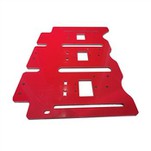
The quality issue of epoxy board is a comprehensive reflection of the quality issues in various processes such as epoxy resin, gluing, and pressing. Although pressing is the last critical process in epoxy board manufacturing, the quality of the semi-finished products produced in the previous process will have a direct impact on the quality of the board.
(1) Surface pitting. This phenomenon is often prone to occur in thin plates, mainly with adhesive paper cloth, especially the surface material with low adhesive content, low soluble resin content, and poor resin fluidity. If there are only thin sheet tasks due to product specifications limitations, the pad paper needs to be thickened and replaced frequently. The preheating time should not be too long, and the pressure should follow closely. In addition, the temperature of the hot plate should not be too high during glue flow.
(2) The surface is uneven and corrugated. This phenomenon often occurs in adhesive paperboard with high resin content and low solubility. Due to the low fluidity of the resin, the uneven amount of adhesive during gluing is prone to uneven and corrugated surface reactions on the laminated board.
(3) Laminate cracking phenomenon. It mainly occurs on relatively thick paper and cloth boards, and in severe cases, cracking occurs in laminates with a thickness of 5mm or more. Epoxy phenolic glass cloth board is not easy to crack, which is due to the strong adhesive force of the adhesive.
(4) The color in the middle of the surface is dark. Whitening around is mainly due to the large amount of volatile matter in the adhesive tape cloth. During preheating, volatile matter is easy to escape around, and there is a large amount of residual volatile matter in the middle. Therefore, the surrounding areas are white and the middle color is dark. This can be determined from the low voltage resistance of the middle part of the board compared to the white part at the edge, which can be attributed to volatile matter.
(5) Surface fracturing. If the resin is pressed too quickly during flow, which will damage the substrate, it is necessary to strictly control the number of times and pressure of the adhesive tape cloth during flow.
6) Surface area adhesive. The thickness deviation of the reinforced material wood body is large, which can cause uneven adhesive amount or deficiency in the gluing machine, causing the adhesive paper cloth to crush the glass cloth. Excessive adhesive content at a certain position, uneven fluidity, uneven heat transfer of the hot plate during preheating, high soluble resin content, and rapid pressure during resin flow.
(7) The thickness deviation of the laminate is large. The common thickness deviation is that the edge is thick and the middle is thin, which is mainly caused by the uneven edges of the steel plate. Therefore, steel plates should be carefully stored, and if any edges are found to have grooves, they should be flattened before use. There is also a phenomenon of thin adhesive tape with large deviation, which is mainly caused by the aging and tender adhesive tape at one time, or the high and low temperature on one side of the hot plate, as well as the tilting of the hot plate. Therefore, when preparing materials, it is necessary to note and boil a part of the adhesive tape and adjust it upside down to 180 °, and the inlet and outlet of the pipeline are staggered.
(8) The board slides out. When pressing, adhesive tape slides out of the steel plate, especially when pressing epoxy phenolic glass cloth board, which is commonly referred to as "material leakage". There are many reasons for material leakage, such as excessive and tender adhesive amount on the adhesive tape, uneven adhesive amount on both sides, uneven material preparation, improper loading, excessive pressure during preheating and glue flow, and uneven force on the hot plate itself, which can cause material leakage. Material leakage can cause personal and equipment accidents, and it is necessary to pay attention to prevention.