Hey there! As a supplier of FRP pultruded profiles, I often get asked about the coefficient of thermal expansion of these nifty products. So, I thought I'd take a deep dive into this topic and share everything you need to know.
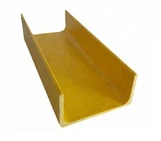
First off, let's quickly go over what FRP pultruded profiles are. FRP stands for Fiber - Reinforced Polymer. These profiles are made through a pultrusion process, where continuous fibers like glass, carbon, or aramid are pulled through a resin bath and then through a heated die to form a solid, strong, and lightweight profile. They come in various shapes and sizes, such as FRP Pultruded Rectangular Profile, FRP Pultruded Half Round Profile, and FRP Pultruded Square Tube.
Now, the coefficient of thermal expansion (CTE) is a measure of how much a material expands or contracts when its temperature changes. It's usually expressed in units of length per length per degree Celsius (or Fahrenheit). For example, if a material has a CTE of 10 x 10⁻⁶ /°C, it means that for every 1°C increase in temperature, a 1 - meter long piece of that material will expand by 10 micrometers.
The CTE of FRP pultruded profiles can vary quite a bit depending on several factors. One of the main factors is the type of fiber used. Glass fibers, which are very commonly used in FRP, have a relatively low CTE compared to some other materials. Carbon fibers, on the other hand, have an even lower CTE, and in some cases, can even have a negative CTE in certain directions.


The resin system also plays a crucial role. Different resins have different thermal properties. For instance, polyester resins are widely used in FRP pultrusion because they are cost - effective. However, they generally have a higher CTE compared to epoxy resins. Epoxy resins offer better dimensional stability due to their lower CTE, which makes them a great choice for applications where precise dimensions are critical.
Another factor that affects the CTE of FRP pultruded profiles is the fiber volume fraction. The more fibers there are in the profile, the lower the overall CTE of the profile is likely to be. This is because fibers typically have a lower CTE than the resin matrix. So, if you increase the fiber content, you're essentially increasing the proportion of the material with a lower CTE, which in turn reduces the overall CTE of the profile.
Let's talk about why the CTE of FRP pultruded profiles matters. In many applications, temperature changes are inevitable. If a material has a high CTE, it can lead to significant dimensional changes when the temperature fluctuates. This can be a big problem in applications where tight tolerances are required. For example, in construction, if an FRP beam expands too much during hot weather, it could cause structural issues or damage to the surrounding components.
In electrical applications, the CTE is also important. FRP profiles are often used in electrical enclosures and support structures. If the CTE is not well - matched with the other components in the system, it can lead to problems such as stress on electrical connections, which can affect the performance and reliability of the electrical equipment.
Now, let's get into some typical values of the CTE for FRP pultruded profiles. Generally, for glass fiber - reinforced polyester FRP profiles, the CTE in the longitudinal direction (along the length of the profile) can range from about 15 - 25 x 10⁻⁶ /°C, while in the transverse direction (perpendicular to the length), it can be around 25 - 40 x 10⁻⁶ /°C. For glass fiber - reinforced epoxy FRP profiles, the CTE in the longitudinal direction is usually in the range of 10 - 20 x 10⁻⁶ /°C, and in the transverse direction, it's around 20 - 30 x 10⁻⁶ /°C.
Carbon fiber - reinforced FRP profiles have even lower CTE values. In the longitudinal direction, the CTE can be close to zero or even negative in some cases. In the transverse direction, it's typically in the range of 5 - 15 x 10⁻⁶ /°C.
When choosing an FRP pultruded profile for a specific application, it's essential to consider the expected temperature range and the required dimensional stability. If you're working in an environment with large temperature variations, you might want to opt for a profile with a lower CTE. For example, if you're building a bridge in a region with extreme temperature differences between summer and winter, using a carbon fiber - reinforced epoxy FRP profile could be a smart choice.
As a supplier of FRP pultruded profiles, I can help you select the right profile based on your specific CTE requirements. We have a wide range of products, including FRP Pultruded Rectangular Profile, FRP Pultruded Half Round Profile, and FRP Pultruded Square Tube, and we can customize the fiber type, resin system, and fiber volume fraction to meet your needs.
If you're in the market for FRP pultruded profiles and want to discuss your project in more detail, don't hesitate to reach out. Whether you're an engineer, a contractor, or someone involved in a DIY project, we're here to provide you with the best solutions. We can offer technical support, samples, and competitive pricing.
In conclusion, the coefficient of thermal expansion of FRP pultruded profiles is a critical property that can significantly impact the performance and suitability of these profiles for different applications. By understanding the factors that affect the CTE and choosing the right profile, you can ensure that your project is successful and reliable. So, if you have any questions or need further information, just drop us a line, and we'll be happy to assist you.
References
- "Handbook of Fiber - Reinforced Polymer Composites for Civil and Infrastructure Engineering"
- "Composite Materials: Design and Applications"