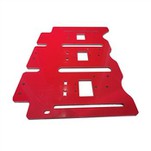
BMC (Bulk Molding Compound), SMC (Sheet Molding Compound) and DMC (Dough Molding Compound) are all thermosetting resin composite materials, and the main difference lies in their form and molding process.
1.BMC (Bulk Molding Compound): BMC is a premixed uncured thermosetting material that contains resin, glass fiber, filler, catalyst and stabilizer. It usually exists in block or granular form, stored in a sealed container, and taken out when needed. BMC is mainly molded by compression molding, and its excellent fluidity makes it very suitable for making high-precision and complex components.
2.SMC (Sheet Molding Compound): SMC is a pre-preg non-curing thermosetting material. When used, it is cut into the required shape and placed in a preheated mold. SMC material has a covering layer under the resin, and the covering layer protects the SMC material, which can effectively prevent the material from being affected by air during storage and transportation. SMC is mainly molded by compression molding. The excellent fluidity and expansibility of SMC materials make it particularly suitable for making large and complex parts.
3.DMC (Dough Molding Compound): DMC is a thermosetting resin composite material that is more viscous than BMC and SMC. Due to the high viscosity of DMC, it has poor fluidity under pressure, so it is often used for manual molding or injection molding. Common uses include complex small parts or high-precision parts.
All three materials have excellent electrical properties, corrosion resistance, dimensional stability and sound absorption, so they are widely used in many fields such as automobiles, construction, electronic equipment and home appliances.
The molding process of these three composite materials usually includes two steps: molding and curing, and the mold temperature controller plays a key role here. The mold temperature controller, usually refers to the mold temperature controller, which can accurately control the temperature of the mold to ensure that the composite material can proceed smoothly during the heating, compression and curing process, and finally form a product with stable structure and qualified performance.